Search has changed more in the last two years than in the previous twenty. If your business relies on being found through Google — and almost every business does — the ground has shifted under your website, whether you’ve noticed or not.
Here’s what’s actually happening, with the numbers behind it, and what it means for how you invest in your online presence.
The answer, not the link, is now the product
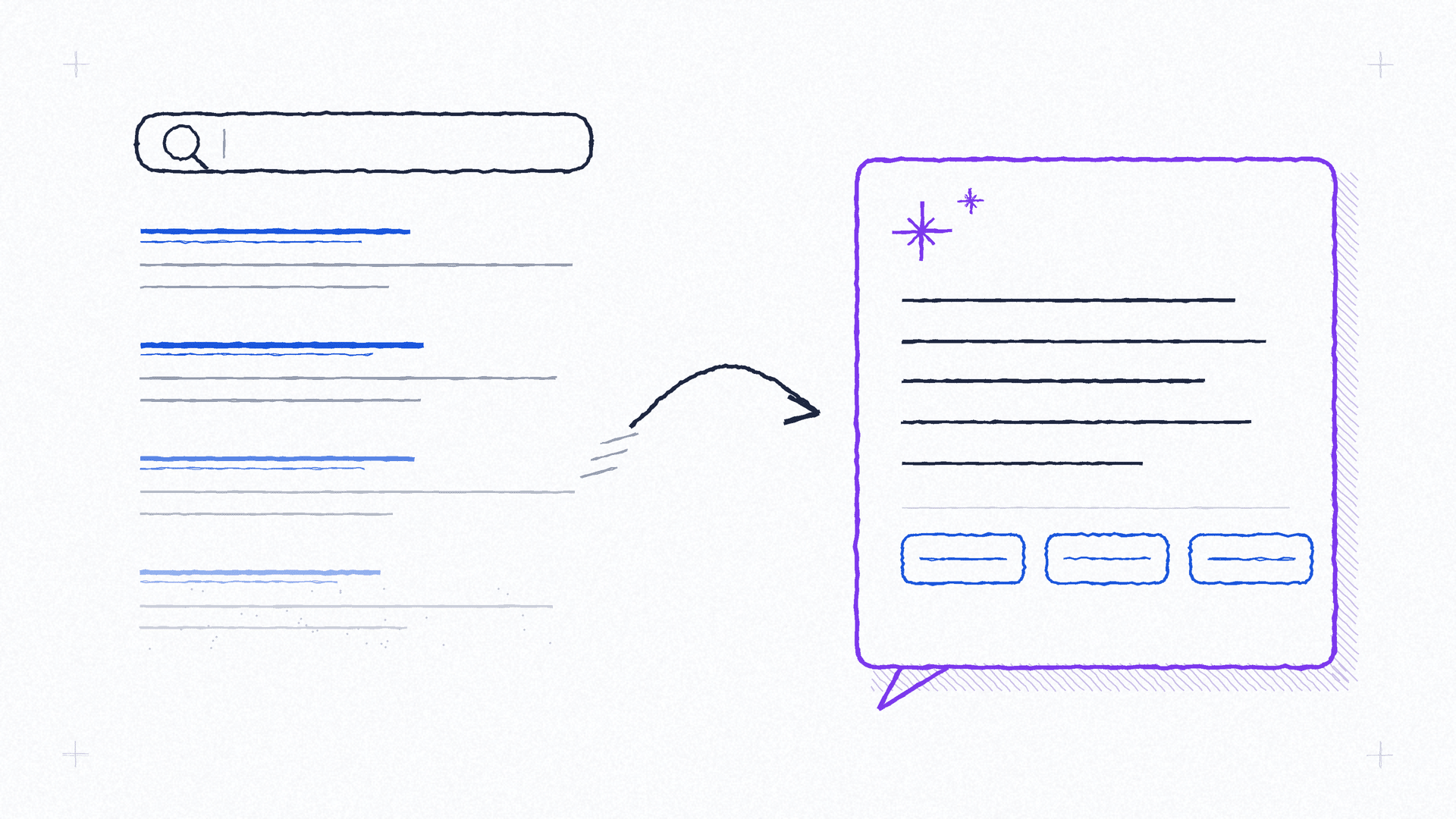
For twenty-odd years, Google worked the same way: you typed a question, it showed you ten blue links, and you clicked one. The whole discipline of SEO was built around winning that click.
Today, an AI-generated answer increasingly sits between the searcher and those links. Google’s AI Overviews — the AI summary at the top of results — now appear on roughly a quarter of searches and reach around 2.5 billion people a month. Google’s fully conversational AI Mode passed a billion monthly users this spring. And a growing number of people skip Google entirely: ChatGPT alone handles around 2.5 billion prompts a day, with roughly 37% of AI users now starting product research in an AI tool rather than a search engine.
The click collapse — and why it isn’t the whole story
The most measurable effect is on clicks. Around 68% of Google searches in the US now end without a click to any website — up from about 58% just two years ago, according to SparkToro and Similarweb’s clickstream research. When an AI Overview appears, that jumps to roughly 83%. In AI Mode, it’s 93%.
For the websites that used to win those clicks, the impact is real. Seer Interactive tracked 5.47 million queries and found organic click-through rates fell 61% on searches showing an AI Overview. Ahrefs measured a 58% drop for the top-ranking page across 300,000 keywords. Different methods, same direction.
But here’s the part most coverage misses: this is a repricing of traffic, not a death sentence. Two findings matter more than the scary headline:
- Being cited in the AI answer pays. Seer found brands cited inside AI Overviews saw around 35% higher click-through rates, while non-cited brands took the full decline. Visibility has moved inside the answer.
- The decline is levelling off. The same research recorded click-through rates stabilising and partially recovering in early 2026 — a new normal, not an endless slide.
The surprising upside: AI visitors convert far better
When someone does click through from ChatGPT, Perplexity or an AI Overview, they’ve usually already done their research inside the conversation — compared options, asked follow-ups, narrowed a shortlist. They arrive ready to act.
AI referrals are still a small slice of most sites’ traffic — typically around 1% — but they’re the fastest-growing and highest-intent slice. Most businesses can’t even see this channel: analytics tools often mislabel AI visits as “direct” traffic. Setting up proper tracking is a small job with a big payoff in understanding.
Local search: the shortlist is shrinking
If you’re a local service business, the change is arriving through your Google Business Profile. AI Overviews now appear on local searches, and in some cases an AI-generated local pack is replacing the familiar three-business map box — sometimes recommending just one or two businesses.
Ask an AI assistant for “the best installer near me who offers finance” and you get a recommendation, not a map. That recommendation is assembled from your Business Profile, your reviews, and what third parties say about you online. The businesses that win are the ones whose profiles are complete and active, whose reviews are recent and specific, and whose details are consistent everywhere they appear. Fewer surfaced businesses means the contested asset is no longer a ranking — it’s a recommendation slot.
What to actually do about it
The good news comes from Google itself. Its official documentation states there are “no additional requirements to appear in AI Overviews or AI Mode” — the AI features run on the same search index and ranking systems as ever. The fundamentals still decide who gets retrieved and cited. In practice, five things matter most:
- Measure the new channel. Set up analytics to see AI referral traffic separately, and watch branded search volume — people who see you in an AI answer often search your name later rather than clicking.
- Publish what AI can’t synthesise. Generic explainers are being absorbed into AI answers. Original data, genuine first-hand experience, honest comparisons and strong opinions still earn both citations and clicks.
- Structure content to be quotable. Direct answers near the top, clear headings, and schema markup make your pages easy for AI systems to retrieve and cite.
- Invest in reputation, not just your own site. Analysis suggests the large majority of AI citations come from third-party sources — reviews, press, industry coverage — rather than brand-owned pages.
- For local businesses, treat your Google Business Profile as your shop window. Complete every field, keep it active, respond to reviews, and keep your details consistent across the web.
The bottom line
Search didn’t die — the click did, for simple informational questions. Visibility now means being cited and recommended, not just ranked. The traffic that still arrives is worth more, because the research happened before the visit. And the work that wins — a fast site, genuine expertise, structured content, strong reviews, a complete business profile — is the same work good SEO always required. It’s just measured on a new scoreboard.
Statistics cited are current as of July 2026, drawn from SparkToro/Similarweb, Seer Interactive, Ahrefs, Pew Research and Google’s Search Central documentation. This landscape moves quickly — figures are best treated as directional.